Looking for a condo or townhome in central Indianapolis? You are not alone, and you are probably also wondering how far your budget will stretch, what the monthly fees really mean, and whether downtown living is worth the tradeoffs. If you want less upkeep, a shorter commute, and a home that fits an urban or near-urban lifestyle, this guide will help you compare your options and buy with more confidence. Let’s dive in.
Central Indianapolis price ranges
If you are shopping for attached housing in central Indy, the first thing to know is that prices vary a lot by neighborhood, building style, and amenities. Across Indianapolis, Redfin currently shows 329 condos for sale at a median listing price of $210,000 and 58 townhouses at a median listing price of $325,000.
Downtown pricing sits well above the broader market. Downtown Indianapolis currently shows 89 condos at a median listing price of $380,000 and 5 townhouses at a median listing price of $804,000. That lines up with the higher sale prices in ZIP code 46204, which reported a February 2026 median sale price of $337,000.
For many buyers, it helps to think in three rough price bands. These bands are not strict rules, but they are a useful way to frame your search.
Entry-level attached homes
In central Indy, entry-level options often land around $100,000 to $180,000. This range can include smaller downtown studio or one-bedroom condos and some Near Eastside townhome options.
If your main goal is to own close to the city core without taking on a detached house, this price band can be a smart starting point. You may need to be flexible on square footage, finishes, or parking.
Mainstream central Indy options
A large share of central Indianapolis condos and townhomes falls in the $250,000 to $400,000 range. This is where many listings cluster in downtown, Fountain Square, and parts of 46202.
For buyers in this range, you can often expect a stronger mix of location, livable space, and updated interiors. This is also a common sweet spot for buyers who want urban access without jumping into the luxury tier.
Premium downtown properties
Higher-end attached homes often start around $500,000 and can move well beyond $800,000. These properties may include larger lofts, newer infill townhomes, garage-heavy layouts, rooftop terraces, or prime downtown locations.
If you are comparing these homes to detached options, the value often comes from location, design, and convenience rather than yard space. That makes it especially important to decide what features matter most to your daily life.
Condo vs townhome in Indianapolis
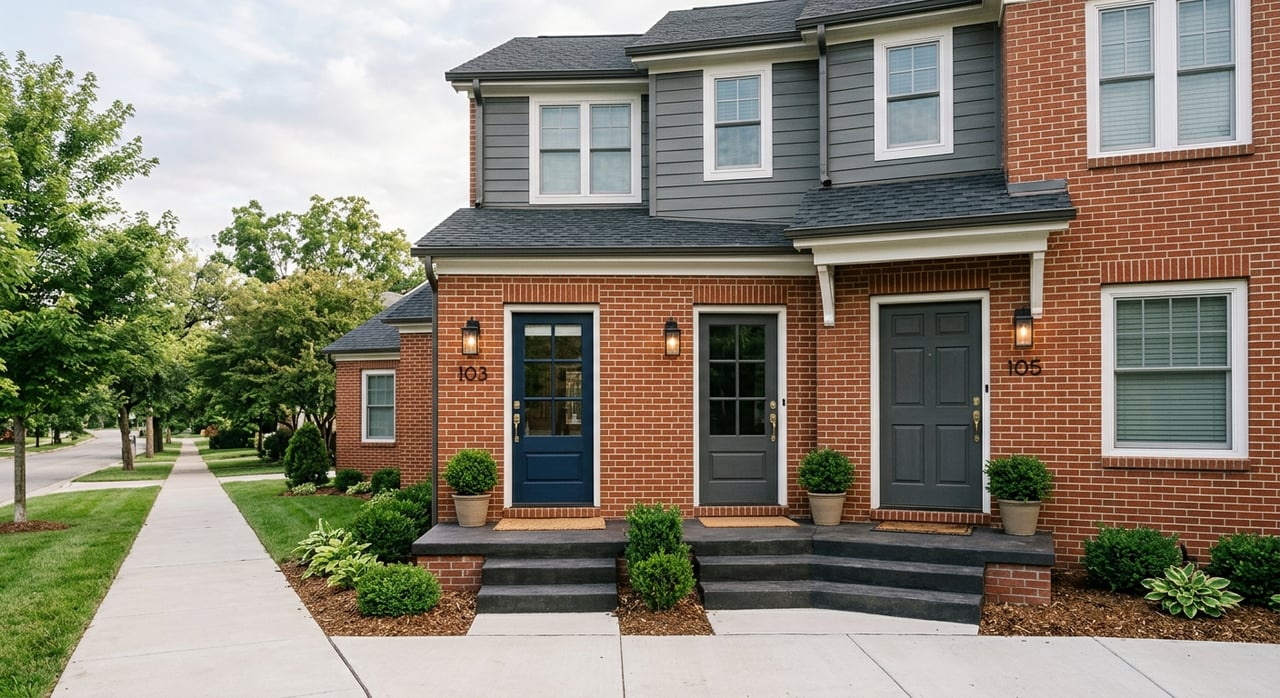
A condo and a townhome can look similar from the street, but the ownership structure may be very different. In central Indianapolis, the townhome label is often used loosely in marketing, so you should not rely on the listing title alone.
What matters most is what you actually own and what the association maintains. The declaration and HOA documents will spell that out, and those details can affect your monthly costs, insurance needs, and future flexibility.
Typical condo layouts
Central Indianapolis condos often lean toward compact one- and two-bedroom floor plans. Current downtown examples range from a 447-square-foot studio or one-bedroom to larger one-bedroom and two-bedroom units over 1,000 square feet, plus premium residences above 2,000 square feet.
Many condo buildings in the urban core are historic conversions or loft-style properties. Depending on the building, you may see exposed brick, secure entrances, rooftop terraces, garages, fitness centers, or pools.
Typical townhome layouts
Townhomes in central Indianapolis are often two to three bedrooms with two to three-and-a-half baths. Many current examples range from about 1,300 to 2,300 square feet.
In areas like Fountain Square and downtown, townhomes may offer more vertical living space, attached garages, and a little more separation than a typical condo unit. That can appeal to buyers who want city living but still need space for guests, a home office, or extra storage.
What monthly fees really cover
One of the biggest surprises for first-time condo and townhome buyers is the role of HOA or condo fees. These dues are usually paid directly to the association rather than rolled into your mortgage payment, unless they are escrowed.
The fee itself is only part of the story. What matters just as much is what that fee covers and whether the association is planning well for future repairs.
Common items included in dues
Condo or HOA fees commonly help pay for:
- Exterior maintenance
- Common-area maintenance
- Water, sewer, or trash in some communities
- Amenities such as fitness centers or pools
- Association insurance for shared areas
- Reserve funding for future repairs
Some communities also include parking or storage, while others charge separately. That is why two homes with similar list prices can have very different true monthly costs.
Why reserves matter
Indiana condominium law requires associations to maintain a replacement reserve fund for capital expenditures and for replacing or repairing common areas. That is a big deal for buyers.
A healthy reserve fund can reduce the chance of surprise costs when a roof, elevator, exterior surface, or major shared system needs work. A low monthly fee may look attractive at first, but it is not always a bargain if the association is underfunded.
Special assessments to watch for
You should also ask whether any special assessments are planned or likely. A special assessment is an extra charge owners may have to pay when reserve funds are not enough for major projects or unexpected repairs.
Before you make an offer, review the budget, reserve information, and any known upcoming projects. That step can tell you a lot about the health of the building and the predictability of your ownership costs.
Budget beyond the list price
When you buy a condo or townhome, your monthly housing cost usually includes more than principal and interest. To budget clearly, you will want to look at the full ownership picture.
That may include:
- Mortgage payment
- Property taxes
- Association dues
- Individual condo insurance
- Utilities not covered by the association
- Parking or storage fees
- Possible special assessments
This is where a side-by-side cost comparison can help. A lower-priced condo with high dues may cost more each month than a slightly pricier home with lower fees and fewer add-ons.
Insurance works differently
Insurance for a condo is not exactly the same as insurance for a detached house. In many condo communities, the association carries a master policy for the building and common areas, while you carry an individual policy for your unit.
That split matters because the master policy may not cover everything inside your home. You should ask whether it covers only the shell of the unit or whether it also includes interior elements and fixtures.
Questions to ask about insurance
Before you buy, make sure you understand:
- What the association’s master policy covers
- What you need to insure personally
- Whether the master policy covers full replacement costs
- Whether there are coverage gaps for fixtures or interior finishes
These answers can affect both your monthly budget and your peace of mind after closing.
Lifestyle tradeoffs in central Indy
For many buyers, the appeal of a condo or townhome comes down to lifestyle. You may give up yard space and some privacy, but you can gain easier maintenance, shared exterior responsibilities, and a location closer to where you work or spend time.
That tradeoff is especially noticeable in central Indianapolis, where walkability changes a lot by neighborhood. Downtown Indianapolis has a Walk Score of 77, Fountain Square 73, and Near Eastside 52, while Indianapolis overall is 31.
Why walkability matters
If you want to be able to get to restaurants, events, coffee shops, or daily errands with less driving, central neighborhoods can offer a very different experience from more auto-oriented areas. That can be a major quality-of-life upgrade if you value convenience and city energy.
For buyers who want less exterior maintenance and a shorter commute, attached housing in central Indy often makes a lot of sense. If you want a large yard, more separation from neighbors, or fewer association rules, a detached home may be a better fit.
Urban versus suburban attached homes
It is also worth noting that suburban attached housing is not automatically cheaper. Fishers currently shows condos at a median listing price of $287,000 and townhouses at $327,000, while Lawrence shows condos at $175,000 and one townhouse at $390,000.
That means the real differences are often not just price. They are more likely to be things like parking, building age, layout, lot pattern, and how walkable the location feels day to day.
Smart questions before you offer
If you are serious about a specific condo or townhome, your due diligence matters as much as the showing itself. The legal structure, fees, reserves, and rules can all shape whether the home is a good long-term fit.
Before you write an offer, make sure you can answer these questions:
- What exactly does the monthly fee cover?
- How much money is in reserve?
- Are special assessments planned or likely?
- Is parking or storage included?
- What does the master insurance policy cover?
- What insurance will you need on your own?
- What are the rental, pet, and exterior-modification rules?
These are not just technical details. They affect your monthly budget, your future flexibility, and how comfortable you will feel living in the community.
Who condo and townhome living fits best
In central Indianapolis, condos and townhomes are often a strong fit for buyers who want a lower-maintenance home in an urban or near-urban setting. They can work especially well if you value location, convenience, and simpler exterior upkeep over private outdoor space.
That is why attached housing is popular with many first-time buyers, young professionals, and anyone looking to stay close to downtown, Fountain Square, or the Near Eastside without taking on the full maintenance load of a detached property. The right fit depends less on the label and more on how you want to live.
If you want help comparing buildings, decoding HOA documents, or narrowing your search in downtown and central Indy, Mariah Barlow can help you cut through the noise and find the right fit with local insight and hands-on guidance.
FAQs
What is the typical price range for a central Indianapolis condo or townhome?
- Central Indianapolis attached homes often fall into three rough bands: about $100,000 to $180,000 for entry-level options, $250,000 to $400,000 for mainstream options, and $500,000 to $800,000 or more for premium downtown properties.
What is the difference between a condo and a townhome in Indianapolis?
- In Indianapolis, the marketing label does not always tell the full story. The key difference is the legal ownership structure and what the association maintains, so you should review the declaration and HOA documents carefully.
What do condo or HOA fees usually cover in central Indianapolis?
- Fees commonly cover exterior and common-area maintenance and may also include water, sewer, trash, amenities, association insurance, and reserve funding, depending on the community.
What should you ask before buying a downtown Indianapolis condo?
- You should ask what the monthly fee covers, how much is in reserve, whether special assessments are planned, whether parking or storage is included, what the master insurance policy covers, and what rules apply to rentals, pets, and exterior changes.
Are downtown Indianapolis condos more expensive than the rest of the city?
- Often, yes. Downtown Indianapolis currently shows a median listing price of $380,000 for condos, compared with $210,000 for condos across Indianapolis overall.
Is a central Indianapolis townhome better than a single-family home?
- It depends on your lifestyle. A townhome may be a better fit if you want less exterior maintenance and a more urban location, while a single-family home may suit you better if you want a larger yard, more privacy, or fewer association rules.